




Acrylic corner brackets are clear, L-shaped fixings used to join two panels at a 90° right angle — in display cases, cabinet carcasses, storage boxes, shelving, and assembly work where a metal bracket would either show through, rust, or both. Available in clear, white, and black, with self-adhesive tape or bolt-fix configurations. Polypropylene (PP) versions are available for chemical or wet environments.
Corner, angle, or shelf bracket — which type?
Use corner and angle brackets — the L-shaped, 90° type — for panel connections where two faces meet and need holding square. Use shelf brackets where the main job is visible support along an edge rather than a join. Both types are available in the same acrylic material; the geometry is what differs.
The corner bracket sits inside the join, invisible from the outside face. That is why clear acrylic is the standard choice: against glass, acrylic sheet, or a light-coloured panel, the bracket disappears entirely. The acrylic L bracket works for the same job — the name varies between sellers, but the product is the same 90° right-angle fixing. Acrylic right angle brackets, acrylic angle brackets, Perspex corner brackets: all the same category (Perspex is a brand name for acrylic sheet, same base material). What changes is the size, thickness, number of holes, and whether the fixing is tape or bolt.
Tape or bolts — choosing the right fix
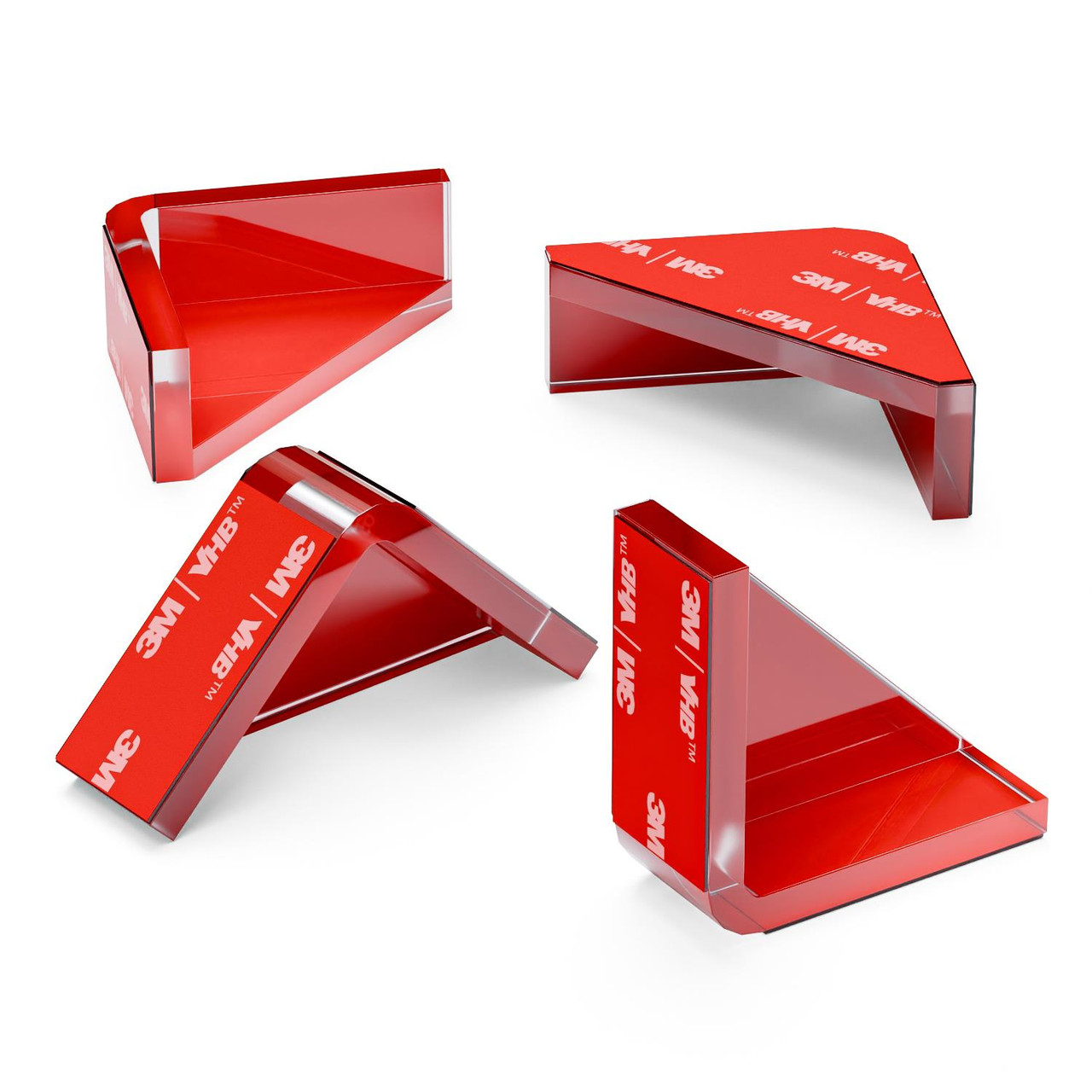
The self-adhesive versions have pre-applied translucent double-sided tape on the rear face. Peel off the liner, press firmly to the corner — no tools, no drilling, no clamp time. Full bond strength develops over 24 hours, so don't load the joint immediately. These suit display cases, acrylic box assembly, cabinet interiors, and anywhere a clean exterior finish matters more than future disassembly.
Surface preparation is everything with tape. The substrate needs to be clean, dry, and free of dust or release film before pressing. Smooth acrylic, glass, powder-coat, and most painted surfaces bond reliably. Textured surfaces, HDPE, or anything with a silicone release coating won't.
The bolt-fix versions come with pre-drilled 5mm holes — 10mm from the edge to the centre point of each hole — and all M5 bolts, nuts, and washers included in the pack. Use these where the joint may need to come apart, where the substrate doesn't bond well to tape, or where the panel assembly is heavy enough to need a mechanical fix rather than adhesive. The V4 reinforced bracket has 8 holes rather than 4 and comes with 40 M5 bolts — for heavier builds where extra fixing points matter.
Some versions include both: tape pre-applied to the rear and bolt holes drilled through. You can fix with tape alone, bolts alone, or both together.
Clear, white, or black — and what they're made from
Clear acrylic brackets are the most-used option. Acrylic is a synthetic polymer belonging to the class of thermoplastics — a clear material that resembles glass in many characteristics but offers certain advantages, including greater transparency and being lightweight. The material can transmit up to 92% of visible light, making it a good alternative to glass. Against a clear panel or sheet, the bracket is practically invisible. All our clear brackets have a polished gloss finish and are manufactured as a single solid piece — no seams.
White and black brackets are acrylic/polycarbonate (Acrylic/PC). White suits light-coloured cabinet and display work where the fixing should read as part of the structure. Black suits darker enclosures, industrial applications, and builds where the bracket will be visible and should match the overall finish. Polycarbonate demonstrates good thermal stability up to 120°C — 40°C higher than acrylic's sustained limit — and offers impact resistance around 200 times greater than glass. The trade-off is UV performance: polycarbonate has lower UV resistance than acrylic, so for prolonged outdoor sun exposure, clear acrylic is the stronger choice of the two.
PP (polypropylene) versions are available on request for applications where acrylic's chemical resistance falls short. Polypropylene exhibits excellent chemical resistance to many acids, alkalis, oils, and solvents, and it does not absorb water — making it well-suited to humid and wet environments. The density is 0.90 g/cm³, the lowest among commodity plastics, making PP brackets lighter than their acrylic equivalents. Note that PP is inherently opaque; it can be produced in translucent or coloured formulations, but not in optically clear form. If UV stability matters, note also that polypropylene is susceptible to UV degradation without UV stabilisers added during manufacture. Contact us to discuss PP bracket options.
What people use them for
The most common use is display case and acrylic box assembly — joining side, front, and back panels of an enclosure. The bracket goes inside the corner, out of sight from the front face. Beyond that: cabinet carcass construction, panel-to-wall fixing, shelf support in damp areas where metal would rust, greenhouse and cold frame glazing bar joins, aquarium cover assembly, exhibition stand construction, and retail display fixtures where a clean finish is part of the brief.
Corner brackets for acrylic sheets and panels also work for flat wall-mounting — the bracket holds the panel from behind with no hardware visible on the face. For shelving, the shelf bracket versions provide visible edge support and are available in the same polished clear finish.
Acrylic demonstrates inherent UV resistance and can block up to 90% of UV radiation, which is one reason it suits outdoor display and signage applications — and outperforms most transparent plastics including polycarbonate in UV stability.
How to fit acrylic corner brackets
Self-adhesive (tape fix):
- Clean both panel faces at the corner. Remove dust, grease, and any protective film. An isopropanol wipe works well; leave to dry fully.
- Dry-fit the bracket into the corner to confirm position before committing.
- Peel the backing liner from the pre-applied tape on the bracket's rear face.
- Press firmly into position for 30 seconds. Do not load the joint for 24 hours — the tape needs time to reach full bond strength.
Bolt fix:
- Position the bracket in the corner. Holes are pre-drilled at 5mm diameter, 10mm from the edge to hole centre.
- Mark through the holes onto both panel faces.
- Drill and insert the included M5 bolts. Fit nuts and washers finger-tight first, check alignment, then tighten fully.
Common questions
What are the pros and cons of acrylic brackets?
The main advantages: optical clarity (92% light transmission), UV resistance, lightweight (1.20 g/cm³ — half the weight of glass), and impact strength better than glass or polystyrene. No rusting, no corrosion, polished finish. The limitations worth knowing: acrylic has poor resistance to organic solvents — acetone, MEK, and similar will dissolve or swell the material. It scratches under abrasive contact, though it is easily polishable, which allows removal of fine scratches and restoration of optical clarity. Sustained temperatures above 80°C affect structural integrity; for higher heat applications, polycarbonate or PP is the better direction.
Are acrylic corner brackets strong enough for shelving?
Acrylic is a strong and tough material that demonstrates good impact strength, even better than glass or polystyrene. It can withstand moderate loads without deformation occurring. For light to medium shelf loads in ambient conditions, acrylic shelf brackets perform well. For heavy loads, use the V4 reinforced bracket (8 holes, 40 x M5 bolts) or combine tape and bolt fixing. Polycarbonate versions offer higher impact resistance if the shelf will take significant weight or knocks.
Can I use these outdoors?
Clear acrylic brackets handle outdoor conditions well — UV resistance is inherent, blocking up to 90% of UV radiation, and the material is moisture-resistant. Temperature range is –40°C to 80°C sustained. The main outdoor limitation is chemical resistance: avoid organic solvent contact and clean with mild soap and water only. If the application involves chemical splash or prolonged wet contact, PP versions are the better specification.
Acrylic or polycarbonate — which should I use?
Acrylic is more economical and better suited where tensile and flexural strength, UV resistance, and transparency are the priorities. Polycarbonate offers improved impact strength and better chemical and heat resistance — up to 120°C versus acrylic's 80°C, and significantly tougher under impact. For most display and assembly work, acrylic is the standard choice. For applications with high impact risk or elevated temperatures, polycarbonate/PC is the right direction.
When to choose a different material
Acrylic has poor chemical resistance to most organic solvents — acetone, MEK, and similar will dissolve or cause the material to swell. If your application involves solvent contact, clean-down with harsh chemicals, or a wet process environment, ask us about polypropylene brackets instead. PP handles a wider range of acids, alkalis, and solvents, and does not absorb water.
Above 80°C sustained, acrylic's structural integrity and optical clarity can be affected. For heated enclosures or high-temperature environments, polycarbonate (up to 120°C) or PP (melting point 160–166°C) are the correct directions.
CLEAR — SELF-ADHESIVE
4x V3, 5mm, Clear Acrylic Corner Bracket — Tape Fix, No Bolts Required
CLEAR — BOLT FIX
V2, 5mm — 4x Brackets + 20x M5 Bolts
V4 Reinforced, 5mm — 4x Brackets + 40x M5 Bolts
Large 70mm, 10x Pack — 50x M5 Bolts
WHITE
White Acrylic Brackets — corner, angle and reinforced
BLACK
Black Acrylic/PC, V3, 5mm — 4x Brackets + 20x M5 Bolts
SHELF BRACKETS & STANDOFFS
Acrylic Shelf Brackets and Standoffs — full range
PP brackets or bulk orders: contact us directly — order direct and save 10%. Free UK delivery.
Browse the full brackets range including hinge brackets, standoffs, and panel fixings.