About this material
PVC can be found in rigid (RPVC) or flexible forms, with the former typically used in construction applications such as pipes, doors, or windows. Other common applications include membership or bank cards and packaging. On the other hand, flexible forms are achieved through the use of plasticizers that soften PVC and enable its use in applications such as electric cable insulation, inflatable products, or rubber substitutes. PVC can also be combined with cotton or linen to produce canvases.
The unmodified PVC obtained from the polymerization process typically requires the incorporation of other agents to achieve the finished product. These agents include various additives, such as plasticizers, heat or UV stabilizers, impact or thermal modifiers, flame retardants, and biocides. The choice of additives depends on the required characteristics of the finished PVC product as well as cost-performance requirements.
Strength
PVC is durable and exhibits good resistance to abrasions and outdoor weathering, though it has limited stress-cracking resistance.
Heat
PVC demonstrates good dimensional stability at ambient temperatures. However, its heat distortion and softening temperatures are low. Additionally, PVC has limited thermal stability, as degradation causes the release of toxic fumes, including hydrogen chloride. Moreover, PVC becomes brittle at low temperatures.
Chemicals, water and electrical properties
PVC demonstrates excellent chemical resistance to acids, alkalis, oils, and most inorganic chemicals. It is also water-resistant. PVC has good electrical properties and high dielectric strength. While the high chlorine content makes PVC naturally flame-resistant, burning it produces toxic fumes.
Sustainability
PVC is difficult to recycle due to the unique blend of additives used for different end-use products.
History
The development of polyvinyl chloride (PVC) began with the first report of vinyl chloride by Liebig and Regnault in 1835. Nearly four decades later, Baumann observed the formation of a tough, white compound. Little progress was made in the following years until the early 1910s, when Fritz Klatte discovered a method for producing PVC. Commercial production began in the USA in the late 1920s. The use of phthalate esters as plasticizers came as an innovation following a patent disclosure in the 1930s, allowing for the synthesis of a technically useful material that could be processed at acceptable temperatures, resulting in soft and flexible products. By the start of World War II, emulsion and suspension technologies were widely used, with development further accelerated by the significant rubber shortage during the war.
After polyethylene (PE) and polypropylene (PP), PVC is the third most widely produced plastic. It is produced through the polymerization of the vinyl chloride monomer, typically via suspension polymerization (80% of production). In manufacturing, the monomer is mixed with water, an initiator, and other additives. To ensure uniform particle size distribution, the reactor is pressurized and continuously mixed to maintain the suspension, with cooling required due to the exothermic nature of the reaction.
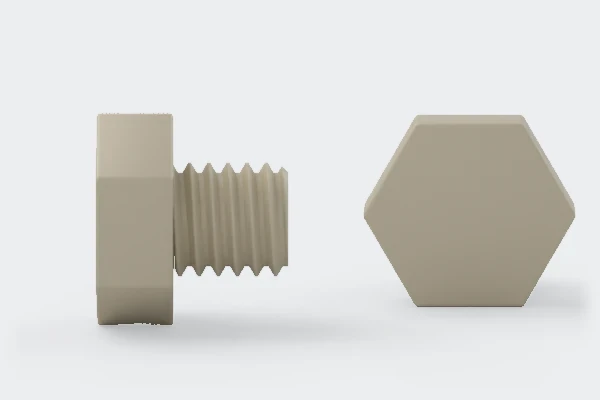
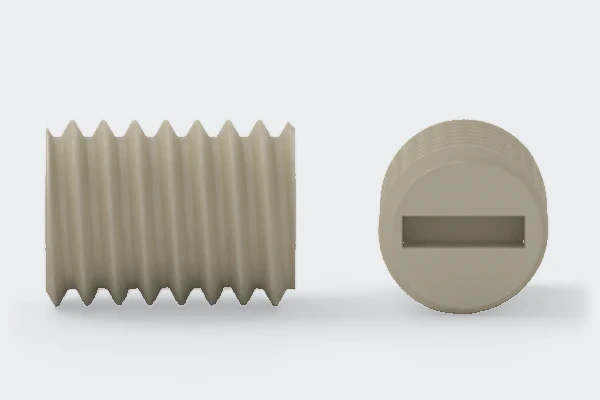
Examples PVC / Polyvinyl Chloride - Bolts, Nuts & WashersBrowse PVC hex head plastic bolts made from polyvinyl chloride (UPVC) for corrosion-resistant fastening. Available in grey color and a range of M4, M5, and M6 sizes, these lightweight, non-metallic fasteners are ideal for assembly, outdoor use, and chemical-resistant applications.