History
Polycarbonates were discovered by German scientist Alfred Einhorn in the late 1890s. However, despite more than 30 years of research into this class of polymers, the project was abandoned, as it had not yielded commercial products. After nearly 50 years with no significant advances reported, research resumed. H. Schnell at Bayer patented the first linear polycarbonate and D. Fox at General Electric filed for a similar patent for a branched polycarbonate. By the 1960s, both companies were commercializing polycarbonate under the trade names of Makrolon (Bayer, 1958) and Lexan (GE Plastics, 1960). Within the next decade, the original brownish color of polycarbonate was improved to the clear material known today.
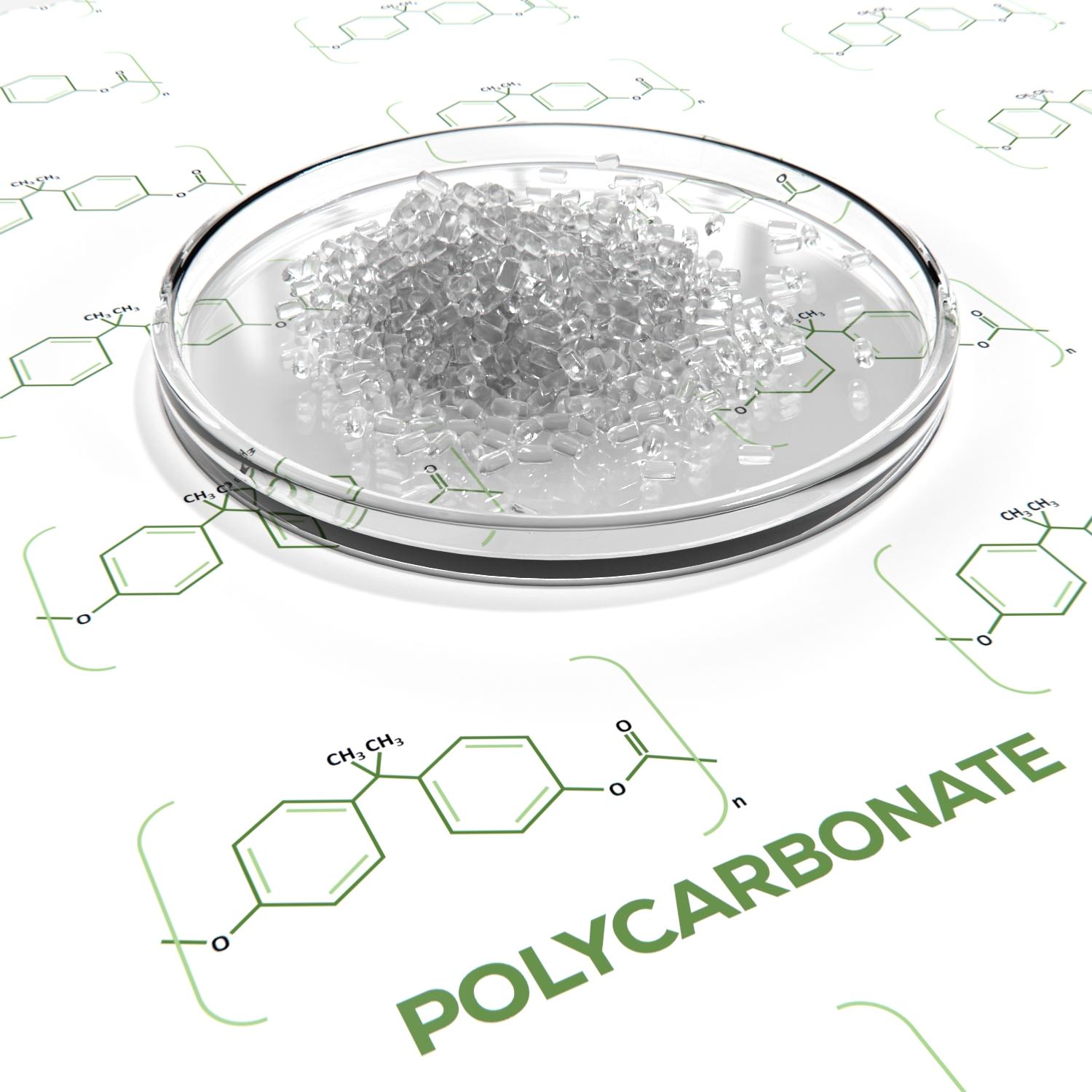
Polycarbonate (PC) is a polymer belonging to the class of thermoplastics, synthesized from the bisphenol A (BPA) monomers linked via carbonate groups (–OCOO–). There are two primary methods for its production: either through a synthetic route involving phosgene or via a transesterification reaction with diphenyl carbonate. Like many polymers, it is petroleum-based, as it relies on the petrochemical industry for the production of BPA and phosgene. However, significant efforts have been made to develop more environmentally friendly production processes, such as carbon dioxide-based production routes that avoid phosgene, plant-based BPA alternatives, non-toxic catalytic processes that minimize waste, and novel recycling methods.
Properties
As with other types of thermoplastics, the individual characteristics of polycarbonate can be fine-tuned through the production processes and the use of additives and copolymers. Additives such as reinforcement fillers for increased strength, plasticizers for improved flexibility, UV stabilizers, or flame retardants can be incorporated to enhance specific properties. Colorants are also added for aesthetic purposes. Blending PC with polyester increases chemical resistance, while blending PC with acrylonitrile butadiene styrene (ABS) can enhance impact resistance and processability.
In terms of processing, injection molding, extrusion, and blow molding yield materials of different characteristics. Injection molding can produce stronger, more precise parts, while extrusion can form continuous profiles like sheets or rods. Crystallinity, optical clarity, and mechanical strength are also fine-tuned through the temperature and cooling rate. For example, slower cooling can improve mechanical strength, whereas a faster cooling process can enhance transparency.
Tensile Strength
Polycarbonate is a very strong and durable material, demonstrating excellent impact resistance (about 200 times more resistant than glass), making it ideal for applications such as bulletproof glass and protective gear like helmets. However, polycarbonate is prone to scratching. As such, a coating is typically required to improve its scratch resistance and enable PC to be used in applications such as eyewear, protective shields, and automotive parts. Another attractive feature is its low density (nearly 50% lighter than glass), making it a lightweight choice for construction and automotive applications where ease of installation and handling is important.
Thermal Stability
Polycarbonate demonstrates good thermal stability within the range of –40 to 120 °C (–40 to 248 °F), better than acrylic, retaining its shape and strength in high-heat environments. It has a high glass transition temperature of 147 °C (297 °F), meaning that the material softens gradually above this point and begins to flow at a temperature of approximately 155 °C (311 °F). Unlike acrylic, polycarbonate is more easily processed, as certain techniques allow it to be processed without heating. While acrylic is brittle and cannot be bent or shaped at room temperature, polycarbonate can undergo deformation without cracking or breaking, making it a useful alternative for applications where sheet metals are unsuitable. Its excellent dimensional stability translates to the material being able to resist mechanical stress and temperature changes without warping or deforming.
Transparency
Polycarbonate resembles glass in transparency, allowing up to 90% of visible light to pass through, thus enabling its use in applications such as windows, eyewear lenses, and optical discs where optical clarity is essential. However, it has low UV resistance, with prolonged exposure to UV radiation leading to degradation and discoloration. The use of UV stabilizers or coatings has greatly improved its UV resistance for outdoor applications. Finally, polycarbonate may become brittle after extended exposure to ionizing radiation above 25 kJ/kg.
Chemical Resistance
Polycarbonate exhibits moderate chemical resistance to mild acids, alcohols, and oils. However, it is susceptible to degradation and cracking when exposed to strong acids, alkalis, and organic solvents such as acetone and benzene Additionally, it has low moisture absorption, allowing it to retain its mechanical properties even in humid or wet conditions. Polycarbonate is also a good electrical insulator, naturally flame-retardant, and self-extinguishing, characteristics that make it an ideal material for applications in electronics, appliances, and automotive parts.
Sustainability
While polycarbonate is an excellent material used in various applications, its environmental impact is also significant. Studies have shown that polycarbonate can hydrolyze to bisphenol A (BPA) under conditions of high humidity and temperatures exceeding 70 °C, a process that may also occur in landfills at environmental temperatures and pH levels. Additionally, under anaerobic conditions, BPA has been shown to persist, indicating that the compound may remain in landfills and eventually reach the aquatic environment, leading to pollution. Importantly, BPA is currently listed as a potentially hazardous chemical by many countries, underscoring the need for caution when disposing of polycarbonate.
As a result, waste and energy consumption management alone are insufficient to mitigate the environmental impact. Alternatives to BPA, sustainable production processes, and effective recycling methods are essential in making polycarbonate more eco-friendly.
Note
While Acrylic and polycarbonate (PC) are similar materials and can often be used interchangeably, several factors may influence one’s choice according to the specific needs of the application. Acrylic is more economical and is better suited for applications where tensile and flexural strength, UV resistance, and transparency are prioritized. On the other hand, PC presents an improved impact strength, as well as better chemical and heat resistance.
Examples Acrylic / Polycarbonate - Bolts, Butterfly Screws, Nuts & WashersDiscover our range of Acrylic / Polycarbonate Bolts, Nuts, Washers, and Screws designed for strength, durability, and optical clarity. With a high impact resistance and lightweight properties, these products are ideal for various applications where reliability and transparency are key. The acrylic material offers excellent resistance to moisture and chemicals, making it a versatile choice for your projects.
Polycarbonate Socket HeadClear socket head bolts in polycarbonate for visible fixings, display work and transparent assemblies that still need an internal hex drive.
PC / PMMA BracketsBrowse our range of durable acrylic brackets, including clear, black, and white options. Choose from corner, right angle, and wall shelf brackets — all precision cut from polished acrylic with included M5 bolts, perfect for shelving, displays, and custom projects.