History
Polypropylene (PP), the most widely used type of thermoplastic, was discovered in 1954 by Giulio Natta and arrived on the commercial market three years later. Its characteristics, such as high temperature and chemical resistance, cost-effectiveness, flexibility, and lowest density among commodity plastics, quickly increased its popularity.
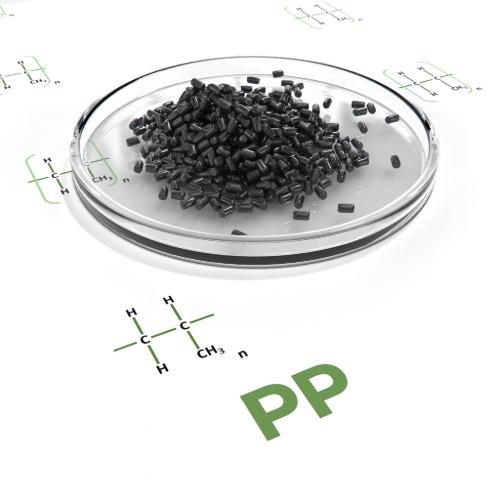
Polypropylene is a downstream petrochemical product obtained from the addition polymerization of the propylene monomer. This process requires heat, high-energy radiation, and an initiator or catalyst. The properties of the polymer may vary depending on the process conditions, molecular weight, and molecular weight distribution. Depending on the polymer’s configuration (isotactic, syndiotactic, or atactic), the intrinsic properties of PP can vary. For example, fully isotactic PP has a melting point of 171 °C, whereas syndiotactic PP has a melting point of 130 °C. Isotactic PP, the most common type commercially available, has a crystallinity between that of low-density polyethylene (LDPE) and that of high-density PE (HDPE).
Properties
When the PP is obtained solely from a propylene monomer, the resulting product product is referred to as homopolymer PP (HPP), which is the most widely used form of this material. The other two general forms of PP are random copolymer and block copolymer. In random copolymers, ethylene monomers are randomly polymerized with propylene to improve transparency, whereas block copolymers improve toughness by including blocks of polymerized ethylene.
The properties of PP can be additionally fine-tuned by using fillers, additives, or reinforcing agents or by blending with other copolymers. As a highly versatile material, it finds use in a range of applications, including fabrics, bottles, medical devices, household goods, and automotive parts.
Tensile Strength
Polypropylene demonstrates a high strength-to-weight ratio, meaning that despite its light weight (density of 0.90 g/cm3), it is strong and durable, making it ideal for applications in automotive parts. Its inherently flexible nature makes this material resistant to stress and stretching and moderately resistant to impact. However, compared to polyethylene (PE), it has slightly lower impact resistance.
Commercial isotactic PP has a melting point range between 160 and 166 °C (320 to 331 °F), indicative of its high-temperature resistance, making it ideal for applications in clinical environments, where items such as trays or bottles need to be sterilized often. On the other hand, PP demonstrates poor low-temperature resistance, as when exposed to temperatures below 0 °C (32 °F), the material becomes brittle. PP also demonstrates significant thermal expansion, albeit to a lesser extent than PE.
Chemical Resistance
Polypropylene exhibits excellent chemical resistance to many acids, alkalis, oils, and solvents, although it is vulnerable to degradation caused by halogenated hydrocarbons, aromatics, and oxidizing agents. Some metals have also been shown to be incompatible with this material, as they accelerate oxidative degradation. Due to its excellent chemical resistance and durability, PP is most widely used in packaging, with notable applications including food containers, bottle caps, and plastic films. Additionally, PP has great moisture resistance, as it does not absorb water, making it suitable for applications in humid or wet environments.
Transparency
PP is inherently opaque, but specific formulations can be used to make the material translucent or transparent. Dyes can also be added for aesthetic purposes, allowing for colored applications. A key disadvantage of polypropylene is its susceptibility to UV degradation with prolonged exposure to sunlight, which leads to discoloration and loss of mechanical properties. The material may thus become brittle and develop surface cracks, decreasing its durability. This can be mitigated through the addition of UV stabilizers during manufacturing to extend its durability.
In addition, polypropylene demonstrates excellent electrical insulating properties, thus enabling its use for electrical or electronic parts. However, the material is flammable, which can limit its applications in certain environments. Flame-retardant additives have been used in formulations where the applications are required to meet specific fire safety regulations.
Sustainability
Polypropylene is recyclable, either through mechanical or chemical processes. However, these processes face challenges and limitations, leading to low recycling rates. Many recycling facilities struggle to efficiently separate PP from other plastics, and contamination with food or other plastics further complicates the recycling process.
Nonetheless, recycling this material is pivotal in mitigating its environmental impact. As a non-biodegradable polymer, PP can take hundreds of years to decompose in landfills. During this process, it breaks down into microplastics, which often end up in marine environments, where PP is one of the most commonly found plastics. This poses significant risks to ecosystems and wildlife, underscoring the need for research into bio-based or biodegradable alternatives alongside more efficient waste and energy management strategies.
Examples PP / Polypropylene - Bolts, Butterfly Screws, Nuts & WashersDiscover the versatile world of PP / Polypropylene materials within the Nuts & Bolts category. Explore a range of innovative solutions crafted from this durable and lightweight material. From fasteners to connectors, PP / Polypropylene offers a unique blend of strength and flexibility for all your project needs.
PP / Polypropylene Hex HeadPolypropylene hex bolts deliver reliable strength, impact resistance, and chemical durability. Ideal for non-metallic applications requiring moisture resistance.
PP / Polypropylene Pan HeadDiscover our range of PP / Polypropylene bolts, nuts, and washers, known for their exceptional chemical resistance, high strength-to-weight ratio, and flexibility. With outstanding physical, mechanical, and electrical properties, these products offer reliable and durable solutions for various applications. Experience the benefits of secure tightening, moisture resistance, and excellent insulation with our Polypropylene hardware.