History
Polyvinylidene fluoride (PVDF) was first discovered by chemists at DuPont in the 1940s as part of their research on fluoropolymers. The company continued the development of PVDF through the 1960s and introduced it to the commercial market in 1965 under the trade name Kynar. This material quickly gained popularity due to its unique properties, including excellent chemical and thermal resistance, along with notable electro-mechanical and piezoelectric characteristics. Initially applied in the chemical processing and electronics sectors, PVDF has since expanded into coatings, solar panel components, lithium-ion battery elements, and wire insulation.
Synthesized
The most accessible method to synthesize PVDF is through radical polymerization of the vinylidene fluoride (VF2) monomer. However, as an asymmetric molecule, VF2 can lead to different polymer isomers. A single regioisomer of PVDF can be achieved via copolymerization of VF2 with either 1-chloro-2,2-difluoroethylene (CVF2) or 1-bromo-2,2-difluoroethylene (BVF2), followed by reductive dehalogenation. This is typically followed by further processing from a solution or through melt casting, producing the non-piezoelectric alpha phase. Stretching or annealing is then required to convert this to the piezoelectric beta phase.
Tensile Strength
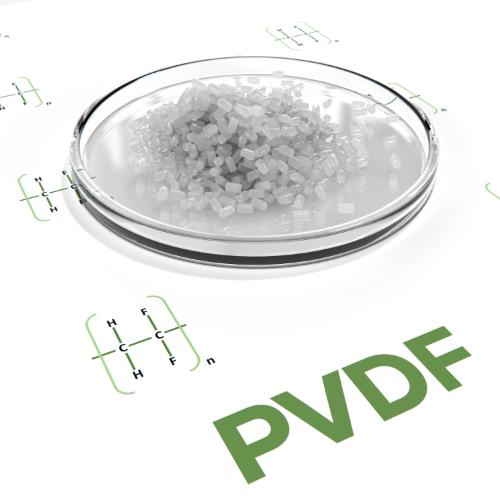
PVDF is a highly pure, non-reactive fluoropolymer belonging to the thermoplastics class. It has a lower density compared with other fluoropolymers (e.g., polytetrafluoroethylene, PTFE), making it easier to handle. The material demonstrates good mechanical strength, tensile strength, and toughness, balancing flexibility and durability. Its strong wear and abrasion resistance makes PVDF an ideal choice for applications requiring high durability and resistance to chemical and thermal stresses
Chemical Properties
PVDF exhibits excellent chemical resistance to most compounds, including acids, halogenated compounds, hydrocarbons, aromatic and aliphatic solvents, oxidants, and weak bases. However, similarly to other fluoropolymers, PVDF is susceptible to degradation by strong bases, caustics, esters, and ketones. Being inherently inert to most chemicals makes PVDF suitable for applications in chemical processing, petrochemical, oil and gas industries, and nuclear waste handling. Additionally, its resistance to chemical corrosion is enhanced by low permeability to most gases and liquids.
Thermal Properties
PVDF has a melting point of 177 °C (351 °F) and is thermally stable between –40 °C and 150 °C (–40 °F and 302 °F). It can withstand prolonged exposure to high temperatures without deformation or significant degradation due to the strong C–F bonds in its structure (the strongest organic bonds). At extreme temperatures over 316 °C (601 °F), PVDF undergoes thermal decomposition via dehydrofluorination. Additionally, PVDF exhibits excellent flame-retardant properties, emitting low amounts of smoke when exposed to flame and not propagating fire easily.
Weather Resistance
Owing to its weather resistance, PVDF is well-suited for outdoor applications. The polymer is inherently resistant to UV radiation, allowing it to remain stable under prolonged sunlight exposure with minimal degradation. This makes PVDF suitable for photovoltaic applications, protective coatings, and solar panels. Its hydrophobic nature repels water, enhancing its suitability for coatings, membranes, and filtration systems. Additionally, PVDF exhibits high resistance to gamma radiation, a property that makes this polymer ideal for medical and nuclear applications.
Dielectric Properties
One of PVDF’s most valuable properties is its electrical behavior. It exhibits excellent dielectric properties and is often employed in applications requiring insulation. Additionally, PVDF displays piezoelectric and pyroelectric properties, generating an electric charge in response to mechanical stress or temperature changes. This has made it useful in sensors, actuators, and transducers. PVDF also has ferroelectric properties, i.e., it can retain electric polarization even after the electric field is removed, a property that is rare among polymers. These unique properties have been exploited in applications such as the manufacture of tactile sensor arrays in the electronics and electricity sector, as well as in biomedical sciences, where PDVF serves as an artificial membrane for the electrical separation of proteins, a process known as immunoblotting.
Sustainability
PVDF’s environmental impact has both advantages and disadvantages. The fluoropolymer is non-biodegradable and can persist in the environment if not disposed of properly. The complex structure of PVDF results in low recycling rates, as it requires specialized processes that are not widely available. Additionally, its production is energy-intensive and uses hazardous fluorine-based chemicals. Although PVDF is generally safe with low leaching properties, extreme thermal decomposition can release toxic gases, such as HF. While PVDF’s long lifespan helps offset its carbon footprint by reducing resource consumption, developing improved recycling processes and greener alternatives is crucial to minimizing its environmental impact.
Examples PVDF / Polyvinylidene Fluoride - Bolts, Nuts & WashersDiscover the innovative world of PVDF / Polyvinylidene Fluoride materials within the Material - Nuts & Bolts category. Explore the unique properties and applications of this versatile thermoplastic polymer, known for its exceptional chemical resistance and durability. From fasteners to sealing components, unlock the potential of PVDF in your next project.
PVDF / Polyvinylidene Fluoride - Socket Head BoltsOur PVDF socket head bolts deliver exceptional chemical resistance, making them ideal for harsh environments, laboratories, and industrial applications. Made from durable polyvinylidene fluoride, these high-performance plastic bolts offer excellent strength, thermal stability, and corrosion resistance, perfect for secure fastening where chemical exposure is a concern.