History
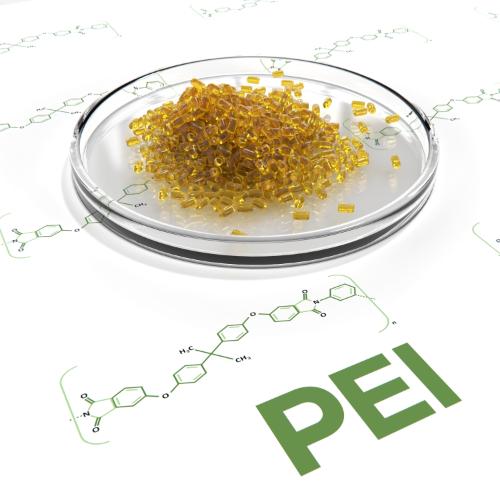
Polyetherimide (PEI) is a high-performance thermoplastic polymer developed in the early 1980s by General Electric Plastics (now part of SABIC) and introduced to the market under the tradename Ultem. While it is similar to polyether ether ketone (PEEK) and developed around the same time, PEI had already become prominent when PEEK was brought to the market by Imperial Chemical Industries (ICI). PEI’s development was driven by the need for novel materials combining excellent mechanical and electrical properties with thermal and chemical resistance. Its target sectors included aerospace, automotive, and electronics, which require materials that can withstand extreme conditions. Due to its exceptional characteristics, PEI has earned a reputation as one of the most versatile high-performance polymers.
Properties
PEI is synthesized through the polycondensation of aromatic bis(ether anhydrides), such as 4,4'-oxydiphthalic anhydride (ODPA), with diamines, such as meta-phenylene diamine (mPDA) or bis(4-aminophenyl) ether, at high temperatures and in aprotic solvents such as N-methylpyrrolidone (NMP). The initial step yields an amic acid intermediate, which, upon heating, cyclizes to form the imide ring characteristic of PEI. The synthesis is controlled to yield high molecular-weight polymers with superior mechanical properties.
The combination of ether and imide linkages and the aromatic backbone gives PEI its high-performance capability and outstanding properties. PEI is processed using standard techniques: extrusion, injection/compression molding, thermoforming, or machining, and requires temperatures between 130 °C and 400 °C (266–752 °F). It has good processability, as it can be machined with high precision and is compatible with additive manufacturing processes.
Tensile Strength
PEI has excellent mechanical properties, including high tensile strength, enabling the polymer to withstand heavy mechanical loads. It also has high stiffness, resisting cracking and maintaining toughness under sudden impacts or varying temperatures. Moreover, PEI ensures long-term stability under sustained loads due to its high creep resistance.
High Performance Polymer
Thermally, PEI is one of the most stable high-performance polymers. It maintains its mechanical properties even with sustained exposure to temperatures as high as 170–200 °C (338–392 °F). Its ability to maintain stability without softening is indicated by its high glass transition temperature of 217 °C (423 °F). This polymer has low thermal conductivity and exhibits a low coefficient of thermal expansion, maintaining dimensional stability under thermal cycling and high-temperature conditions. This high thermal resistance has enabled PEI’s widespread use in the healthcare sector, as it can withstand repeated autoclave conditions.
PEI is an excellent insulator, possessing high dielectric strength. Its electrical insulation properties can withstand a range of temperatures and frequencies, a critical characteristic in the electronics and electrical sectors. PEI exhibits a low dielectric constant, making it suitable for high-frequency communication devices.
Chemical Properties
PEI has excellent chemical resistance to most compounds, including weak acids and bases, organic solvents, hydrocarbons, and oils. However, it is susceptible to degradation by strong bases and strong acids with prolonged exposure. Additionally, PEI is prone to stress cracking in chlorinated solvents. While not hydrophobic, PEI exhibits low moisture absorption, allowing it to withstand humid conditions with minimal impact on its electrical and mechanical properties.
Transparency
PEI offers high light transmittance and clarity, being available in a range of optical grades. This property is advantageous for optical and medical applications, such as lenses or lighting system housings. Moreover, it can be easily colored for aesthetic purposes, increasing its versatility. PEI is UV resistant and performs well even when exposed to gamma or X-ray radiation, enabling its use in outdoor or medical applications.
Other Properties
PEI exhibits good wear resistance and low friction, making it widely used in applications involving sliding or rotational motion. It is also inherently flame-retardant, without the need for additional flame-retardant additives. It emits minimal smoke and toxic gases when exposed to flames, a desirable feature for aerospace and transportation applications where stringent fire safety standards must be met.
Sustainability
PEI’s manufacturing is energy-intensive due to the high temperatures required for processing, contributing to its carbon footprint. Furthermore, the polymer is non-biodegradable, persisting in the environment if improperly disposed of. However, its long service life and durability reduce the need for frequent replacement, minimizing waste and conserving resources. Additionally, owing to its high strength-to-weight ratio, PEI’s use as an alternative to metals helps conserve fuel and energy in certain applications. However, as a high-performance polymer, its recycling remains limited, but advancements in recycling techniques offer promise in addressing this limitation. To minimize PEI’s environmental impact, improved energy and waste management practices and advanced recycling techniques are essential.