History
Discovered and brought to the mainstream market between the 1930s and 1940s by DuPont, polyamide 66 (PA66 or nylon 66) quickly became a popular choice for mass-produced goods due to its durability, chemical resistance, and versatility as a synthetic plastic. As demand for high-strength, heat-resistant, and lightweight materials grew, composites such as PA66+GF were created by adding glass fiber reinforcements to polyamide-type polymers. PA66+GF achieved an excellent combination of glass fiber’s strength and heat resistance with nylon 66’s versatility. By the 1970s and 1980s, the PA66+GF composite had gained significant popularity in the automotive and electronics sectors, where it was used as an alternative for heavier metals. Its applications have since expanded across many industries, with technological advancements allowing for further refinement of its properties. The characteristics of PA66+GF can be fine-tuned to meet end-product requirements by varying the glass fiber content (e.g., 10%, 30%, 50%) and using specific compounding methods to achieve optimal performance.
Properties
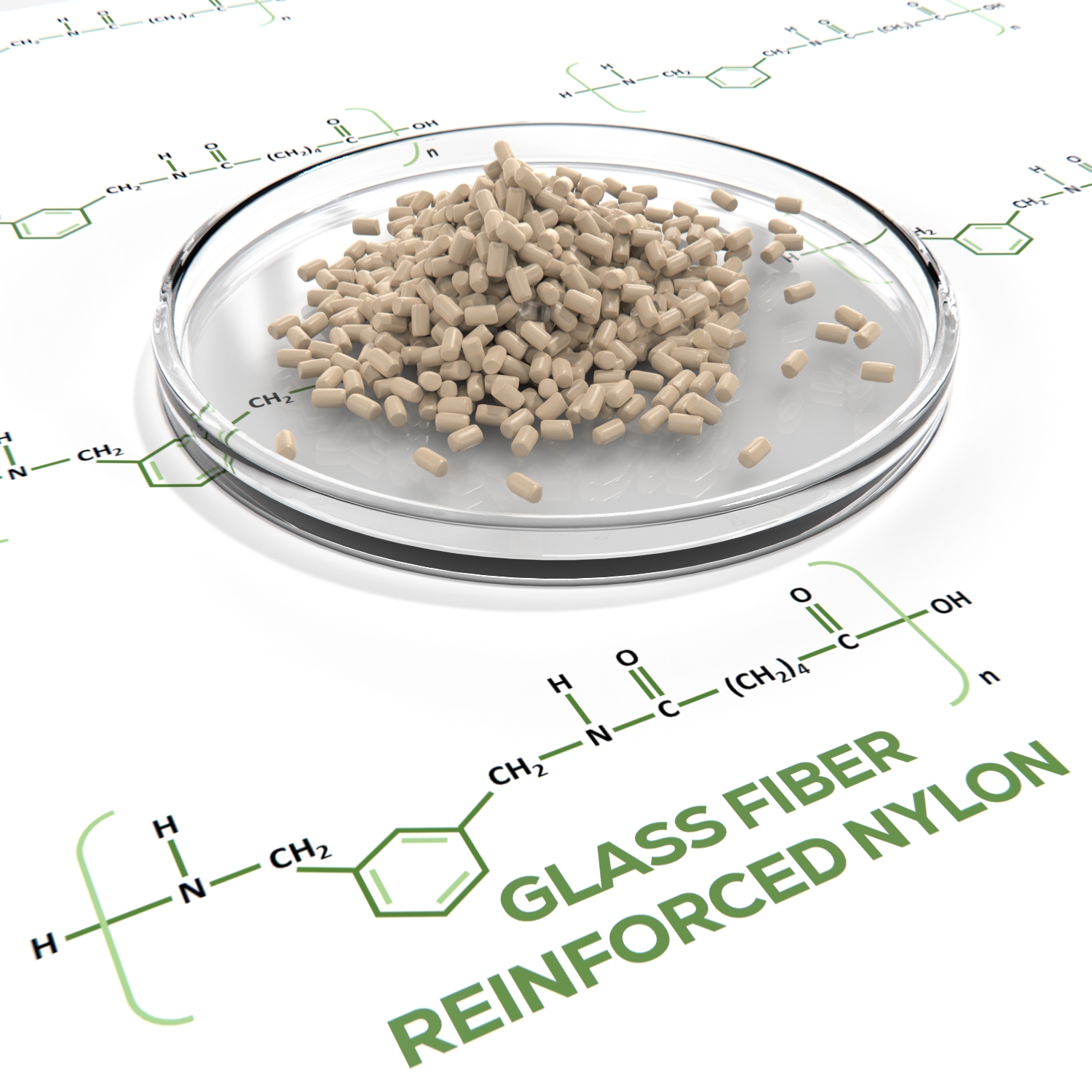
Glass fiber-reinforced polyamide (PA66+GF) is a composite material made from polyamide 66 (PA66) and reinforced with glass fibers for improved mechanical properties. Polyamide 66 is a type of nylon that is manufactured through the polycondensation of two monomers: hexamethylenediamine and adipic acid, each containing six carbon atoms—hence the PA66 name. In addition to superior mechanical characteristics compared with earlier nylon variants, PA66 offers the advantage of low-cost starting materials.
Tensile Strength
PA66+GF demonstrates superior performance in terms of tensile and flexural strength as well as impact resistance. The addition of glass fibers increases PA66’s tensile strength from 75 MPa to 180 MPa or more when the composite contains 30% glass fiber, enabling its use in load-bearing applications. Flexural strength is enhanced compared with PA66; for example, a 30% glass fiber content translates to a flexural strength of roughly 250 MPa. Furthermore, impact resistance and durability are improved, although the composite becomes more brittle compared to the polymer alone. PA66+GF is suitable for applications involving friction or stress, as the composite exhibits superior hardness with improved surface durability and wear resistance.
While glass fiber reinforcements do not alter the melting point of PA66 dramatically, they significantly improve the heat deflection temperature, i.e., the temperature at which the material begins to deform under load. This property translates to improved heat resistance compared with PA66 alone, making the composite suitable for high-heat applications. Although PA66+GF remains an insulator, its thermal conductivity is enhanced. Dimensional stability is also improved due to a lower coefficient of thermal expansion, meaning that the material undergoes expansion to a lesser extent with temperature changes as glass fiber content increases.
Chemical Resistance
The excellent chemical resistance of PA66 to oils, fuels, and solvents is retained in PA66+GF. However, the composite is susceptible to degradation by strong acids and bases, which can damage both the polyamide matrix and the glass fibers. The addition of glass fiber also improves one significant limitation of PA66: moisture absorption. Although PA66 tends to absorb moisture, which can affect its mechanical properties, PA66+GF demonstrates reduced moisture absorption, though it does not become moisture-resistant.
Since glass fibers are not electrically insulating, PA66+GF has a lower dielectric strength than PA66, meaning the composite is a poorer insulator than PA66 Although glass fiber-reinforced PA66 resists electrical conductivity, it is unsuitable for high-voltage applications where insulation is required.
Sustainability
While glass fiber reinforcements yield improved mechanical properties for PA66+GF composites, it is important to consider their environmental impact. The production process of PA66 is energy-intensive, a process that becomes even more demanding when incorporating glass fibers. PA66 is a downstream product of the petrochemical industry, and extracting glass fibers from raw materials, such as silica sand, limestone, or soda ash, also has environmental impacts, for example, habitat disruption and pollution. Like most synthetic polymers, PA66+GF is non-biodegradable, and as such, proper waste management is key to limiting associated pollution.
Reducing PA66+GF’s carbon footprint poses challenges, as recycling the material involves technical difficulties. Glass fibers can degrade during recycling, resulting in products that demonstrate diminished mechanical properties. Mechanical recycling may also damage the matrix and glass fibers. Finally, while in theory, chemical recycling of the composite into PA66 and GF can be achieved, the associated costs and technical limitations make this a complex process and impede large-scale implementation. Advancements in recycling technology, sustainable alternatives to PA66 and glass fibers, and responsible end-of-life management are essential in minimizing the environmental impact.
Examples Nylon PA 66 / 50% Glass Fibre Reinforced — Cross Countersunk HeadDiscover our Nylon PA 66 / 50% Glass Fibre Reinforced collection, featuring Countersunk Cross Head Bolts with superior strength and impact resistance. Derived from nylon 66 and glass fibers, this composite material offers improved tensile strength, deflection temperature, and moisture absorption compared to standard nylon. Perfect for load-bearing applications, these bolts provide durability and reliability in various settings. .
Nylon PA 66 / 50% Glass Fibre Reinforced Pan HeadElevate your projects with our Nylon PA 66 / 50% Glass Fibre Reinforced Pan Cross Head Bolts. Designed for superior strength and thermal resistance, these bolts are ideal for load-bearing applications in automotive, industrial, and consumer goods industries. With enhanced mechanical properties and a high heat deflection temperature, our glass fiber reinforced material ensures reliable performance even under demanding conditions.
Nylon PA 66 / 50% Glass Fibre Reinforced Hex HeadEnhance your fastening solutions with our Nylon PA 66 / 50% Glass Fibre Reinforced Hex Head Bolts. Designed for high strength and thermal resistance, these bolts offer superior tensile and flexural strength, impact resistance, and chemical resistance. Ideal for automotive components, industrial machinery, and consumer goods, these bolts ensure secure and reliable fastening in demanding applications. .