
How it's made
PPS’s ability to withstand harsh conditions, including chemical and thermal attacks, has enabled its use in textiles, electrical insulation, specialty membranes, molding resins, and gaskets. PPS is typically processed through molding or extrusion, but it can also be machined to tight tolerances. An alternative method is 3D printing, especially for low-volume, high-performance components. Additives are widely used to fine-tune the properties of PPS-based products. These include reinforcements, such as glass fibers or carbon fibers, for increased strength, fillers for improved dimensional stability, lubricants or impact modifiers, flame retardants, and UV or thermal stabilizers. PPS processing presents certain challenges, including the high processing temperatures that require specialized equipment and the brittleness of unmodified PPS.
Strength
PPS exhibits excellent tensile strength and rigidity, while reinforced grades containing glass or carbon fibers demonstrate enhanced toughness. The material has dimensional stability, maintaining its shape and mechanical integrity under prolonged mechanical loads. With its low coefficient of thermal expansion, PPS preserves its dimensions under varying temperatures, making it suitable for bearings, gears, and structural components.
Chemicals and water
One of PPS’s main advantages is its chemical resistance. Combined with its resistance to water, steam, and humid conditions, PPS performs well in harsh chemical environments such as those found in chemical processing equipment, fuel systems, and outdoor applications.
Heat, fire and electrical properties
PPS has a melting point of approximately 285 °C (545 °F) and can withstand prolonged exposure to temperatures between 200 and 220 °C (392 to 428 °F) without significant degradation. PPS is naturally flame-retardant.
PPS has good dielectric properties, maintaining its insulating ability even at high temperatures, enabling its use in electrical and electronic components. It also has a low dielectric constant, which minimizes signal loss in electronic devices.
UV and weather
PPS exhibits moderate tolerance to UV radiation, although prolonged exposure to high levels of UV light can lead to degradation. To address this limitation, UV stabilizers can be added during production. These stabilizers enhance UV resistance, enabling PPS’s use in outdoor applications. Its resistance to other environmental factors, including temperature fluctuations, moisture, and oxidation, further supports its suitability for outdoor use. PPS also demonstrates good resistance to X-rays and gamma radiation.
Sustainability
PPS is non-biodegradable. It is a downstream product of the petrochemical industry. Despite ongoing efforts to develop recycling methods for PPS, such methods remain limited.
History
PPS gained commercial significance when Phillips Petroleum developed a refined process that enhanced the material’s stability. Recognizing the commercial potential of PPS as a high-performance thermoplastic, the company established an optimized synthesis route involving the reaction of sodium sulfide with 1,4-dichlorobenzene in NMP. This organic polymer comprises aromatic rings linked by sulfide bridges.
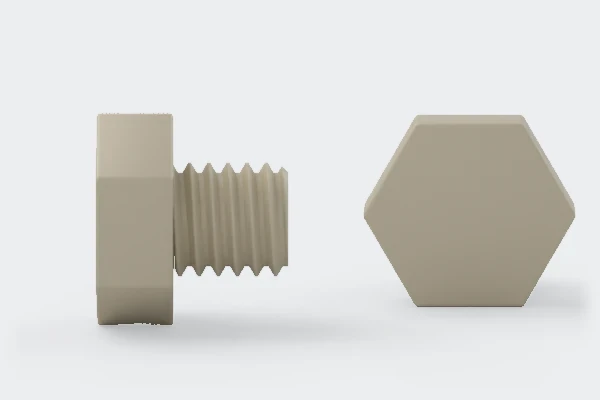
Examples PPS / Polyphenylene Sulfide - Bolts, Nuts & Washers PPS / Polyphenylene Sulfide - Hexagon HeadPPS hex head bolts provide strength, heat resistance, and chemical stability. Ideal for high-performance, industrial, and demanding load applications.