About this material
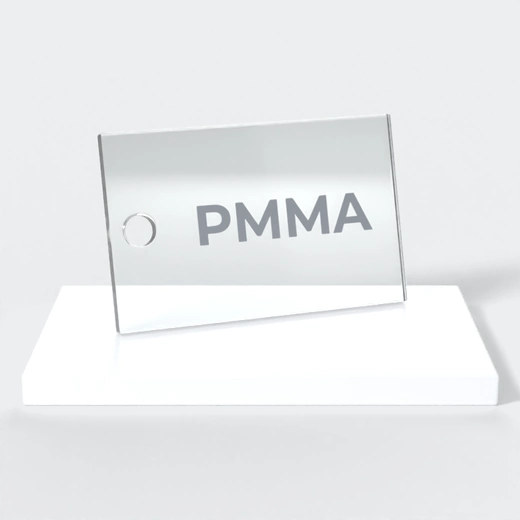
Acrylic is a synthetic polymer belonging to the class of thermoplastics. It is a clear material that resembles glass in many characteristics. Good strength, high transparency, and lightweight properties make acrylic a popular choice for furniture, aquariums, roof panels, and DIY projects. Its production relies on polymerization (emulsion, solution, or bulk) of the methyl methacrylate monomer. It is a petroleum-based polymer as it relies on the petrochemical industry for the production of the required starting monomer, MMA.
Acrylic can be cast, which is suitable for high-end optical and architectural applications, or extruded, making it suitable for applications such as displays and light diffusers. Cell casting yields the highest quality PMMA sheets. Fillers, comonomers, and additives are often used in various formulations of PMMA such that the characteristics of the end material are optimized for its application.
Strength
Acrylic is considered to be a strong and tough material that demonstrates good impact strength, even better than glass or polystyrene. With a density of up to 1.20 g/cm3, it is also up to 50% lighter in weight than glass. Butyl acrylate can be added to the formulation of PMMA to further increase the material’s impact strength. As an organic glass, acrylic is highly durable, making it suitable for outdoor applications. It exhibits low flexibility and can withstand moderate loads without deformation occurring. For most applications, shattering is not a concern, as acrylic tends to break into large, dull pieces. However, it has moderate resistance to friction, with abrasive materials, in particular, being able to cause surface scratches, making the use of scratch-resistant coatings a requirement for certain applications. Moreover, it is easily polishable, allowing for the removal of fine scratches and the restoration of optical clarity.
Chemicals, water and heat
Acrylic has poor chemical resistance, as most organic solvents will either dissolve it or cause the material to swell. Nonetheless, while the material is not highly susceptible to water, it is not waterproof either, demonstrating water absorption of up to 0.4% by weight. Prolonged exposure may alter the material’s mechanical properties and reduce its strength.
Acrylic demonstrates good temperature resistance within the range of –40 to 80 °C (–40 to 176 °F), with long exposure times to a temperature higher than 80 °C resulting in potential loss of structural integrity and optical clarity. The use of additives or comonomers can further enhance the thermal resistance of the material. The glass transition temperature is 105 °C (221 °F), meaning that at room temperature, PMMA is considered an organic glass. Above this temperature, the rigid nature of the material changes to a more flexible state.
Clarity and UV
One of acrylic’s advantages is its transparency; the material can transmit up to 92% of visible light, making it a good alternative to glass. Moreover, it filters ultraviolet (UV) light below 300 nm, with certain additives increasing this range up to 400 nm. Overall, acrylic demonstrates inherent UV resistance. While prolonged exposure to strong UV radiation may cause some surface degradation and color change, acrylic outperforms most transparent plastics, such as polycarbonate (PC). In terms of infrared (IR) light, colored acrylic blocks visible light but allows IR radiation to pass, making it suitable for heat sensor applications.
Sustainability
The industry has made strides in developing chemical methods to break down PMMA back into its monomer, which, after some processing, may be used anew.
Acrylic or polycarbonate?
Acrylic and polycarbonate (PC) are similar materials and can often be used interchangeably. Acrylic is more economical and is better suited for applications where tensile and flexural strength, UV resistance, and transparency are prioritized. On the other hand, PC presents an improved impact strength, as well as better chemical and heat resistance.
History
The development of acrylic started with the discovery of methyl methacrylate (MMA) in the 1870s. In the 1930s, British scientists at Imperial Chemical Industries and German chemists working for Röhm & Haas AG brought polymethyl methacrylate (PMMA) to the market under the trade names Perspex and Plexiglass, respectively. Other names that this material is known by include acrylic glass, Acrylite, and Lucite.
Examples AcrylicAcrylic accessories including standoffs, spheres and locks for display work, spacing, fixing and specialist projects.
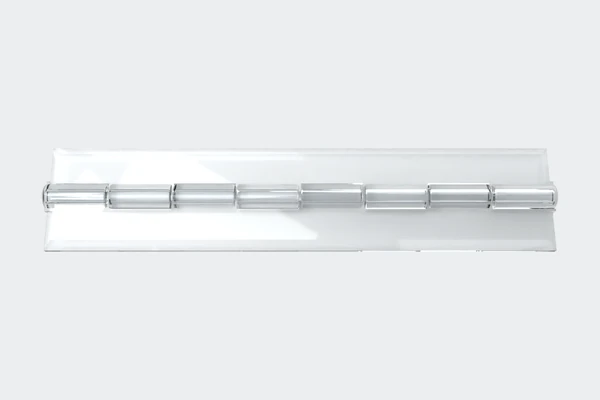
Piano HingesPlastic Acrylic Continuous Hinges, an alternative to traditional metal hinges. Ideal for display cabinets, shelves, and DIY projects.