
How it's made
PEEK synthesis relies on step-growth polymerization through the dialkylation of bisphenolate salts. Typically, hydroquinone is treated with sodium carbonate to generate the reactive disodium salt of hydroquinone in situ, which subsequently reacts with 4,4-difluorobenzophenone. This reaction requires high temperatures of 300 °C (572 °F) and polar aprotic solvents. The degree of crystallinity in the polymer reflects its characteristics and can be fine-tuned through processing conditions used to mold the polymer. Typically, PEEK is processed through injection molding. PEEK can also be processed in its solid state; CNC milling machines are employed to produce thermostable, electrically, and thermally insulating parts.
Strength
PEEK exhibits excellent mechanical properties with high tensile strength, rigidity, and impact resistance, enabling its use in load-bearing parts and structural applications. It has a high strength-to-weight ratio, allowing it to maintain durability across various applications while reducing the part’s weight. Additional advantages of this material include a low friction coefficient and high wear resistance, which enhance its lifespan and reduce maintenance requirements.
Chemicals and water
PEEK is predominantly chemically inert, demonstrating excellent resistance to most acids, bases, and organic solvents. However, at high temperatures, it can be susceptible to degradation by some strong acids, halogens, halogenated compounds, and aliphatic hydrocarbons. PEEK also exhibits exceptional resistance to hydrolysis, making it suitable for use in moist or wet environments. Its resistance to steam and hot water enables applications in medical tools and devices that require repeated autoclave sterilization.
Heat
PEEK exhibits high thermal stability, meaning it can be continuously used at temperatures as high as 250 °C (482 °F) without degradation. With a melting point of 343 °C (649.4 °F), it can withstand even higher temperatures if exposure time is limited. This property makes PEEK ideal for high-heat applications, such as in engines and industrial machinery. Additionally, PEEK’s inherent flame-retardant properties resist combustion, and compared to other materials, it emits low amounts of smoke and minimal toxic gases. These characteristics are crucial for meeting strict fire safety requirements in public transportation or construction applications.
PEEK has excellent dimensional stability, which enables it to withstand high temperatures without deforming under load. This characteristic is vital in applications such as precision machined parts, where maintaining shape and mechanical properties under varying temperatures is essential. Additionally, PEEK exhibits stable electrical insulating properties even in high-heat environments, which enables its use in applications such as connectors and electronic components.
Sustainability
Production of PEEK is energy-intensive due to the high temperatures required for polymerization. Its long lifespan and durability reduce the need for frequent replacements, lowering overall material consumption and reducing energy and waste management demands. Although difficult to separate from other materials, PEEK can be recycled and reprocessed. However, recycling is somewhat limited due to high costs. However, as a non-biodegradable material, PEEK can persist in landfills, making closed-loop recycling practices crucial to minimizing its environmental impact.
History
Polyether ether ketone (PEEK) is a semicrystalline polymer that belongs to the thermoplastics family. The demand for materials that could withstand extreme conditions and meet the requirements of demanding applications led to the development of PEEK in the 1970s by Imperial Chemical Industries (ICI). It was introduced to the market under the trade name Victrex PEEK. The material gained popularity in aerospace, automotive, and industrial applications due to its high performance and excellent mechanical, chemical, and thermal properties. By the 1990s, characteristics such as biocompatibility, high strength, and transparency to X-rays (radiolucency) made PEEK suitable for use in medical fields, with applications such as orthopedic and spinal implants. PEEK has continued to find new applications in industries including oil and gas, electronics, and 3D printing.
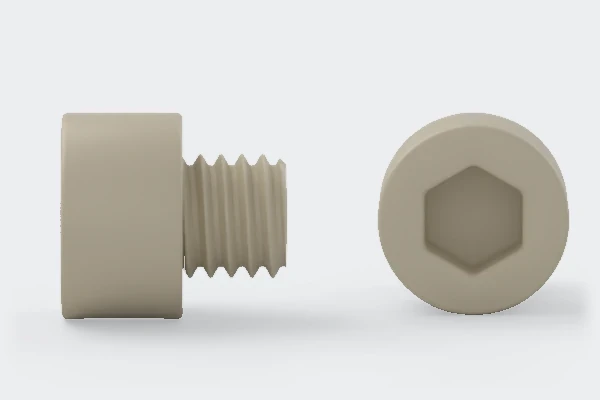
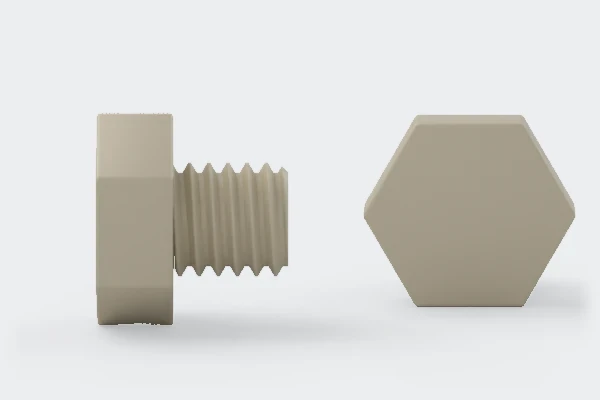
Examples PEEK / Polyether ether Ketone - Nuts, Bolts & Washers PEEK / Polyether ether Ketone Socket HeadPEEK socket head bolts, nuts and washers for compact keyed plastic fastening where heat, chemicals and hydrolysis resistance matter.
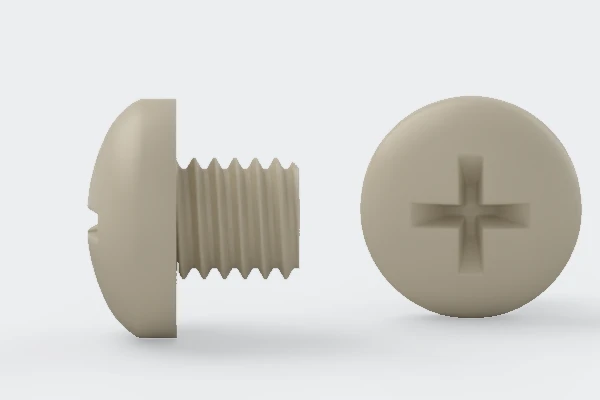
PEEK / Polyether ether Ketone Pan HeadBrowse our PEEK plastic bolts, nuts, and washers. These high strength, chemical, and heat-resistant fasteners are designed for demanding industrial, non-metallic, and extreme environment applications.